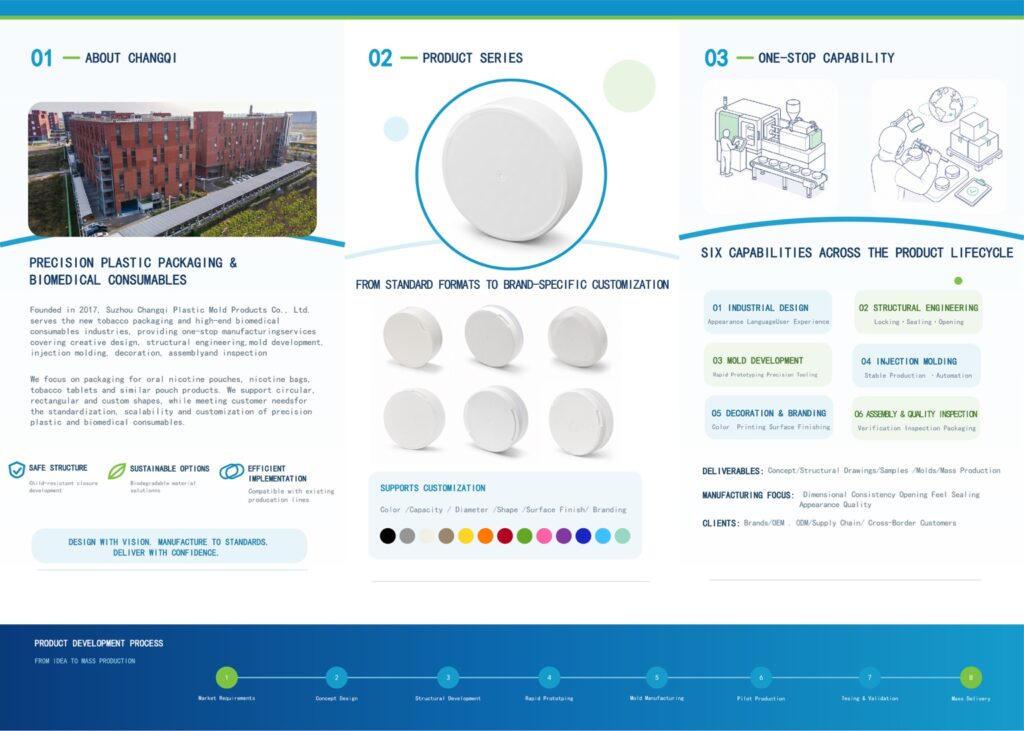

The global nicotine pouch market is still expanding, but the way brands compete has changed. Budgets used to go into flavour, formulation and nicotine strength. Now that consumers face an increasingly crowded shelf, what decides repeat purchase is the complete experience. That unremarkable round can is both the protective layer carrying the product from the factory to an overseas market, and one of the parts the consumer touches most often.
Growth Is Pushing Competition Into the Details
In January 2025 the US Food and Drug Administration, through the premarket tobacco product application pathway, authorised twenty ZYN nicotine pouch products for sale in the United States for the first time. The FDA’s review found that these specific products contain substantially lower levels of several harmful constituents than cigarettes and most smokeless tobacco products, and that adult cigarette or smokeless tobacco users who switch completely to them may see a public health benefit. In the second quarter of 2026 Philip Morris International disclosed ZYN shipments up 2% year on year at 2.9 billion pouches — growth still holding on an already large base.
Authorisation is not a finding of safety, and it does not extend to all nicotine pouches. Nicotine is addictive; minors and non-users should not start. What the public record does signal to the industry is this: nicotine pouches are entering a phase of more mature review, scaled production and real brand operation — and competition is extending from a single formulation to the whole product experience.
One Small Can, Three Moments of Experience
The first moment is transport and storage. Pouches usually cross borders and pass through swings in temperature and humidity. The fit between lid and base, the stability of the material and the sealing approach all affect the state of the contents. Different formulations have different moisture content and shelf-life targets, so moisture resistance cannot be judged by feel — it has to be validated with the actual product through sealing, drop and shelf-life testing.
The second moment is opening and carrying. Whether the action is smooth, whether the close gives clear feedback, whether the lid survives repeated use — all of it feeds the consumer’s read on quality. For markets with child-resistance requirements, the opening logic, the warning marks and the corresponding testing have to be considered in parallel, not retrofitted after the tool has been cut.
The third moment is the shelf and the social setting. An oral nicotine can has very little surface area, yet it has to carry colour, graphics, brand information and tactile quality in that small space. The better the structural proportions, surface texture and decoration work together, the more recognisable the product becomes. Mediocre packaging design, and the brand disappears into the row of lookalikes.

Packaging Competition Has Moved From Appearance to Engineering
Genuinely competitive packaging is not a pretty exterior developed in isolation. It is brand expression converted into a structure that can be produced consistently at volume. At project kick-off a brand should already have settled the target market, the filling equipment, the capacity, the material, the opening method, the decoration process and the transport conditions — and only then work through structural development, rapid prototyping, mould manufacture, pilot runs and validation testing. That is what reduces underfilling, deformation, inconsistent opening force and line-compatibility problems after volume production starts.
The value of a packaging supplier changes accordingly. What a brand needs is no longer just a plastic part, but the ability to connect industrial design, structural engineering, tooling, injection moulding, surface finishing, assembly and quality inspection into one line. The more concentrated the supply chain, the more accurately the design intent survives, and the more efficiently problems can be traced and versions iterated.

An Integrated Supply Chain Saves the Detours
Suzhou Changqi Plastic Mold Products Co., Ltd. focuses on the development and manufacture of oral nicotine plastic packaging, supports customisation from a sample or a drawing, and can develop around different sizes, colours, surface processes and child-resistant structures. As published on the company site, the production system runs 20 injection moulding machines from 100T to 270T and a Class 100,000 GMP cleanroom, covering everything from mould engineering to volume production and quality inspection.
For brands preparing to enter overseas markets, we suggest moving the packaging review to the front of product development: confirm the target regulations and line conditions first, then settle the can format, material, opening experience and validation standards together. That preserves the brand’s differentiation while reducing later tool changes and delivery variance. Specific compliance conclusions should always rest on the target market’s regulations and the certificates and test reports for the corresponding model.
The Next Phase Is About Overall Completeness
Flavour and formulation decide why a consumer tries a product the first time. Packaging keeps deciding whether the product stays in condition, whether it is easy to carry, and whether the brand is worth trusting. As the category shifts from expansion to refined competition, closing the packaging gap gets a brand closer to durable advantage than adding one more flavour.
To discuss oral nicotine packaging customisation, structural development or volume-production fit, get in touch with the engineering team or email jason@szchangqi.com.