

From Swedish snus to today’s nicotine pouch, the change of form looks like it happened inside one small sachet. Behind it sits a reconstruction of ingredients, usage occasions and supply chain standards. Once nicotine pouches reached scale, the thing consumers touch most often stopped being the formulation statement and became the can they open and carry every day. The more mature the product, the less the packaging can stay at the level of “it holds the contents”.
From Swedish Snus to the Nicotine Pouch
Trade press in Chinese often calls snus “Swedish nasal snuff”, but more accurately it is a smokeless oral tobacco placed between the upper lip and the gum. The modern nicotine pouch keeps that oral method of use but contains no tobacco leaf — typically nicotine, a plant fibre base and other ingredients. Because nothing burns, there is no smoke or ash of the kind cigarettes produce, and no electronic device or battery is needed. Portability and discreet use follow directly from that.
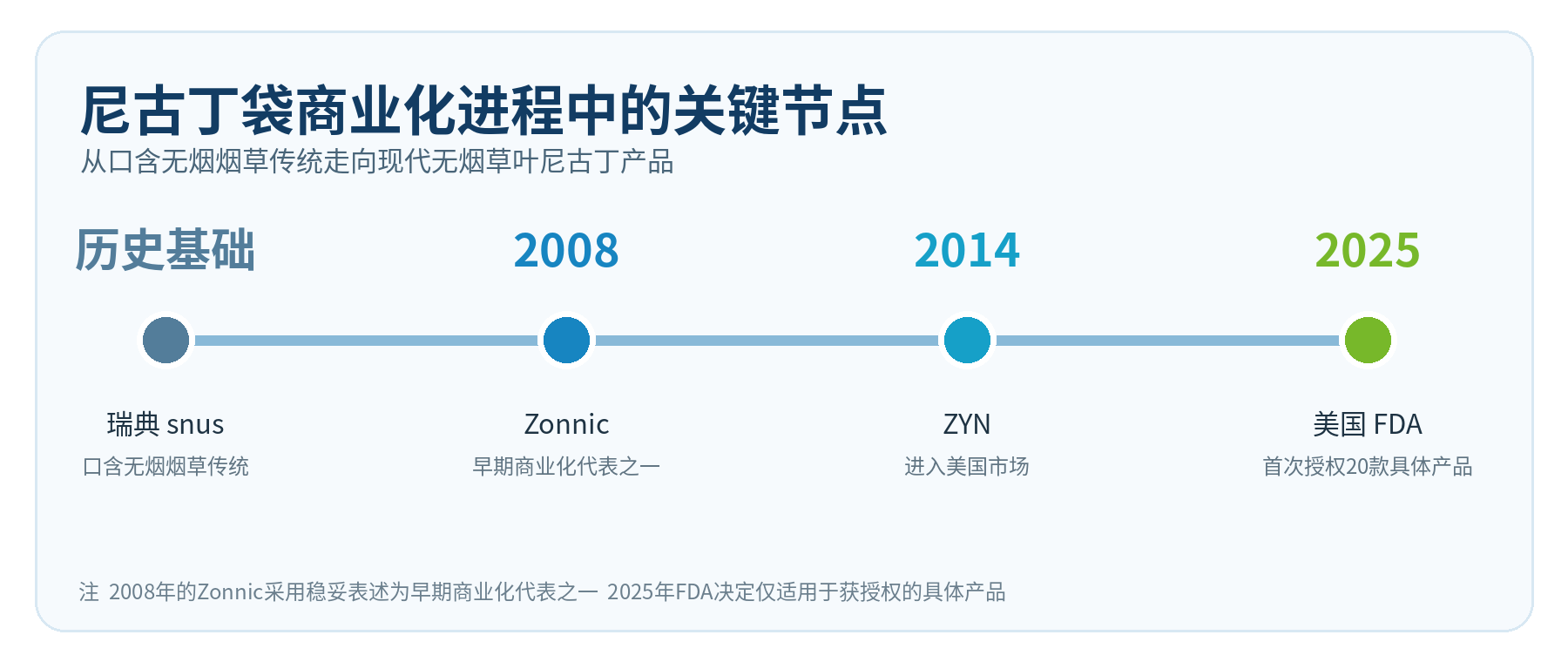
Zonnic, launched in 2008, is one of the representative early commercialised tobacco-free nicotine pouch products. In 2014 Swedish Match took ZYN into the US market. VELO, Nordic Spirit and others expanded after them, and the nicotine pouch moved from a niche derived from Nordic tradition into the wider adult nicotine market.
Regulatory Signals Have Clarified the Category’s Value
On 16 January 2025 the US Food and Drug Administration, through the premarket tobacco product application pathway, authorised twenty specific ZYN nicotine pouch products for sale in the United States. It was the FDA’s first authorisation of nicotine pouch products. In its review the FDA noted that the authorised products contain substantially lower levels of harmful constituents than cigarettes and most smokeless tobacco products, and that there is evidence some adult cigarette or smokeless tobacco users can switch to them completely.
The decision provides an important regulatory signal for the adult-substitution value of nicotine pouches, but the boundary is equally clear: the authorisation applies only to those specific products, and it does not mean they are safe or carry an FDA endorsement of “harmless”. Nicotine is addictive; minors and non-users of nicotine should not use these products. For the industry, the real benefit is that compliant smokeless products are gaining a clearer route through scientific assessment and regulation.
The Product Entered FMCG Logic, and the Pack Became Part of the Experience
As flavour, strength, pouch format and moisture content keep subdividing, the packaging has to move in step. Consumers put the can in a pocket or a bag and open it repeatedly while commuting, working and socialising. Whether the lid runs smoothly, whether it closes securely, whether the edge is comfortable, whether the thickness suits a pocket — all of it feeds directly into how the product feels. The pack has gone from being a shipping container to being part of the brand experience.
At the same time, pouch material is sensitive to its storage environment. The packaging has to limit the effect of ambient moisture and contaminants through transport, shelf life and daily use. Sealing is not a matter of the lid “looking tight” — it depends on the engagement between lid and base, material shrinkage, wall thickness, tolerances, and stability after repeated opening. A generic plastic box that was never designed and validated for this rarely satisfies all of those at once.
The Precision Behind One Round Can
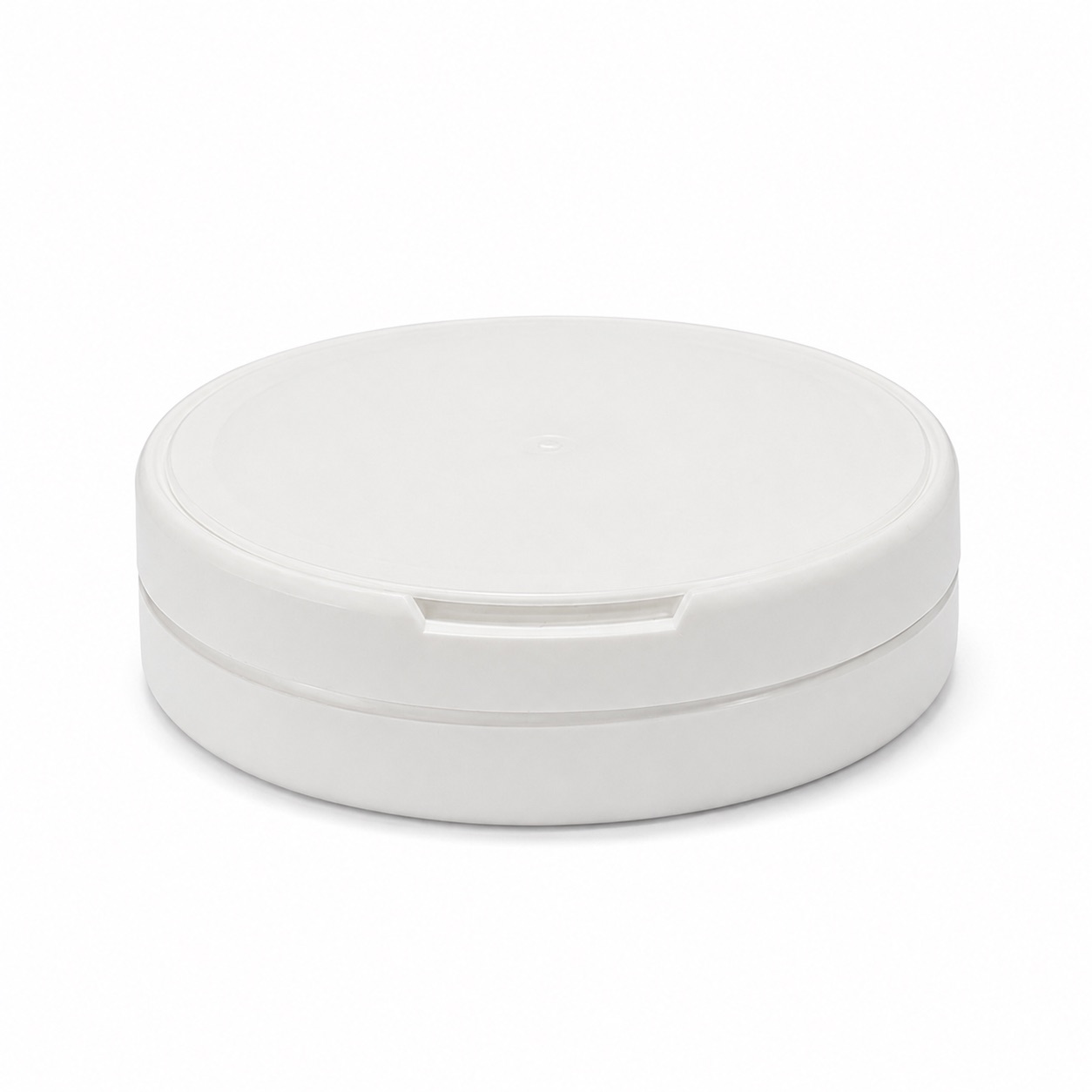
Purpose-built oral nicotine packaging tests mould precision first. If the engagement between lid and base is too loose, closing and protection performance become erratic; too tight, and opening resistance rises and filling line efficiency suffers. Material selection then has to reconcile food-contact compliance, dimensional stability, surface feel and decoration process. For export projects, the packaging also has to account in advance for label area, stacked transport, filling and capping, and the target market’s regulatory requirements.
Child-resistant structure is likewise not something that can stay at the level of an icon or a styling cue. If the target market or the specific product requires child-resistant packaging, it has to be designed from the opening action, the locking structure, durability and adult accessibility, and tested against the applicable standard. Put differently: oral nicotine packaging is both a consumer-goods exterior and a system that has to be validated as engineering.

Keeping Packaging Capability in Step With Product Iteration
Suzhou Changqi is grounded in precision plastics and mould manufacturing, and has built a complete chain around oral nicotine and nicotine pouch packaging: product design, 3D prototyping, mould development, injection production, assembly and inspection. The existing product range covers round cans, flip-top, double-opening, three-opening, bottom-storage and child-resistant structures — standard specifications can shorten development time, and customisation can be built around a specific requirement. On the production side the company maintains its own mould machining capability and injection equipment in Taicang, Suzhou, and supports volume delivery with a quality system, clean production and batch traceability.
More importantly, packaging development can start from the brand’s requirement and its existing filling line, checking feeding, filling, capping, labelling and cartoning in advance and reducing the rounds of adjustment before launch. For brands preparing to enter overseas markets or upgrade an existing line, the earlier packaging engineering enters product development, the easier it is to satisfy experience, efficiency and compliance together.

To discuss standard oral nicotine cans, child-resistant structures or a custom tooling programme, send us the project requirement or email jason@szchangqi.com.