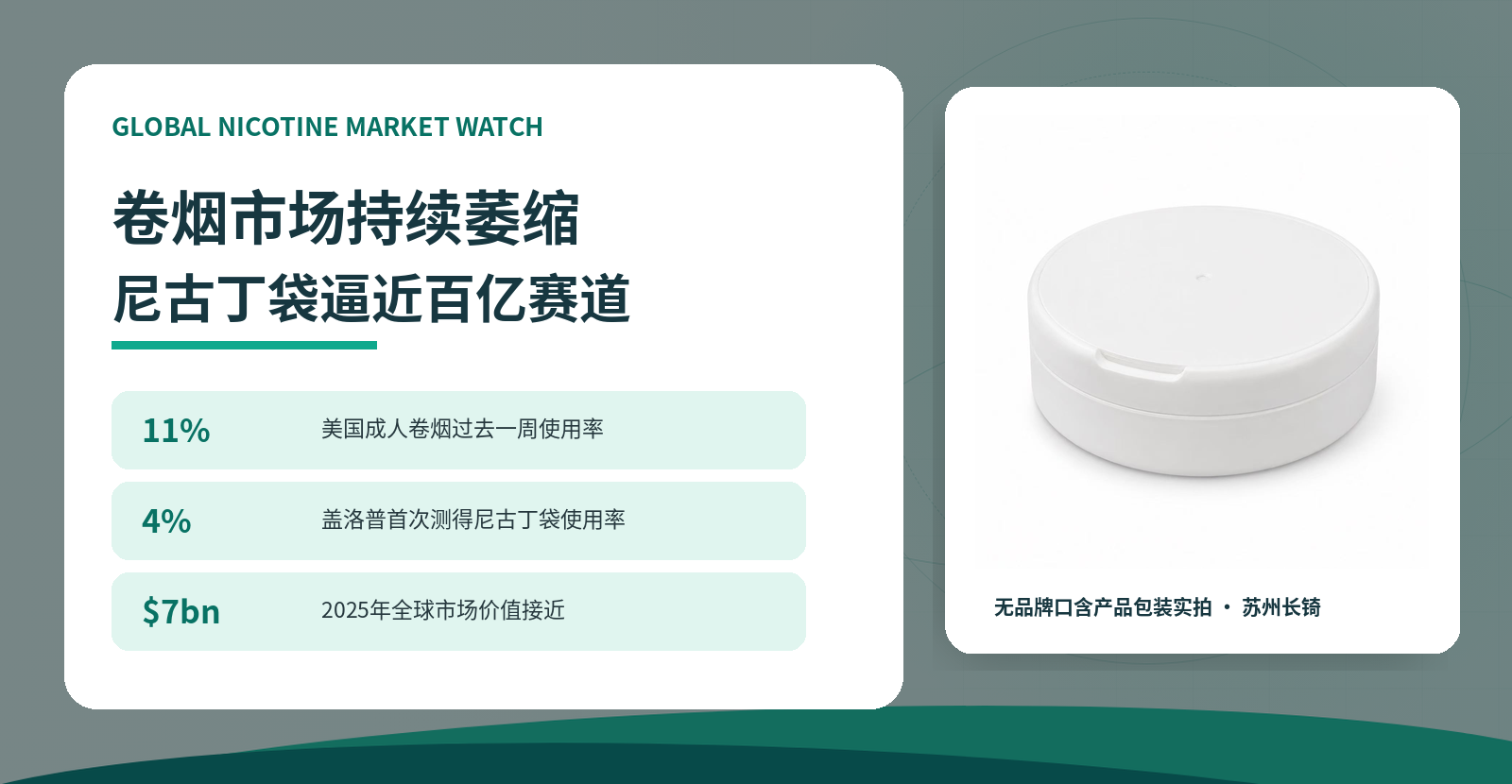
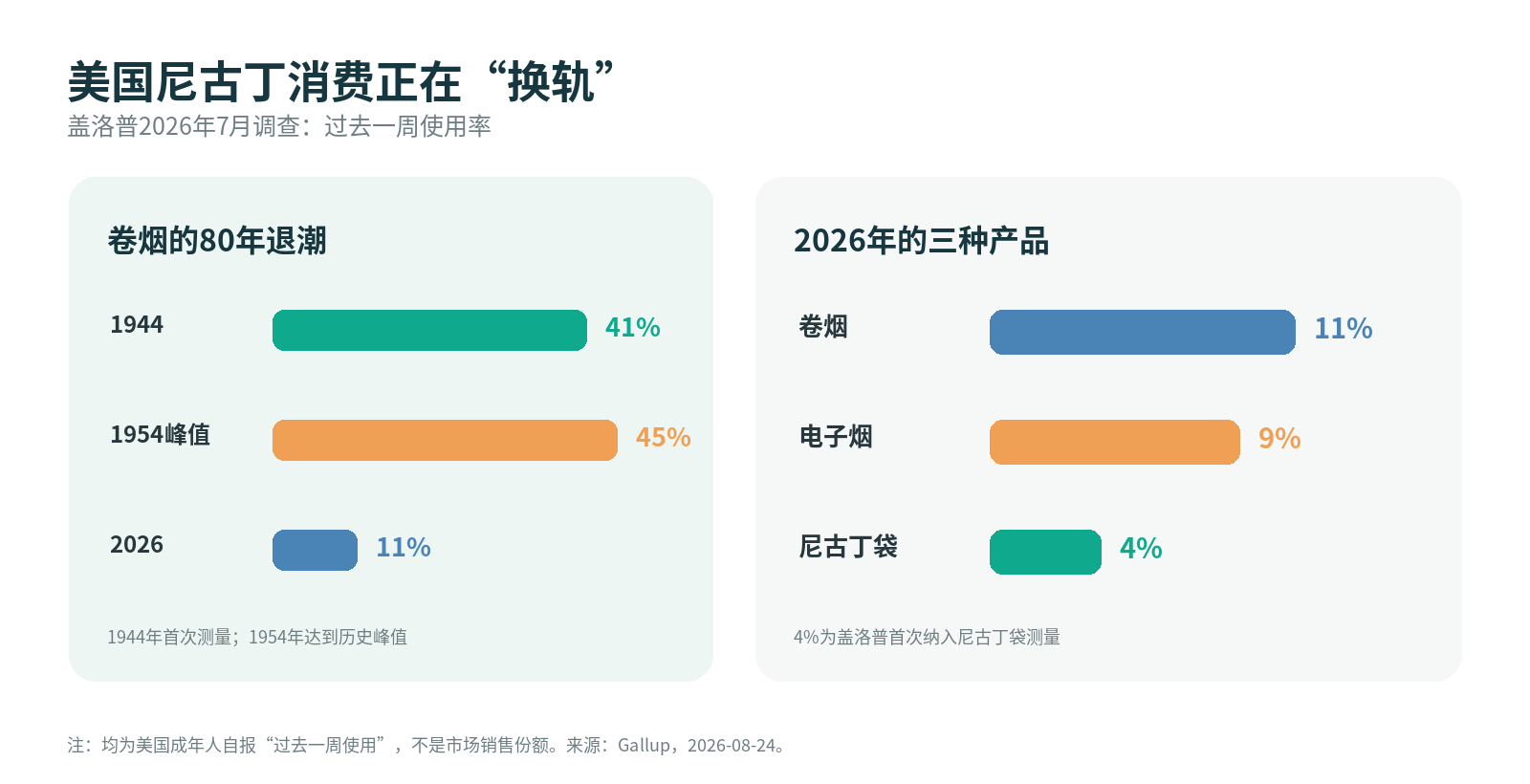
What loosened the cigarette era may not be another cigarette, but a small white pouch that needs no flame, depends on no device, and goes straight into a pocket. On 24 August 2026 Gallup published its July consumption habits survey: 11% of US adults had used cigarettes in the past week, 9% vapes, and nicotine pouches reached 4% on their first inclusion in the survey. That is not market share, but it is the most direct thermometer of migrating consumer behaviour.
The Cigarette’s Retreat Has Run for a Full Eighty Years
In 1944, when Gallup first asked Americans about smoking, 41% of adults said they smoked; by 1954 that had risen to a historic peak of 45%. The curve has fallen ever since — below 30% in 1989, consistently under 20% from 2015, and down to 11% in 2026. A national consumer product that once covered nearly half of all adults has contracted to roughly one person in nine.
But the demand did not simply vanish. It reorganised. Vaping sits steady at 9%, and nicotine pouches reached 4% on first measurement. If cigarettes represent the combustion era and vapes the device era, then what the nicotine pouch represents is a route much closer to fast-moving consumer goods: no smoke, no device, low burden.
4% Looks Small, but It Is a Starting Point That Cannot Be Ignored
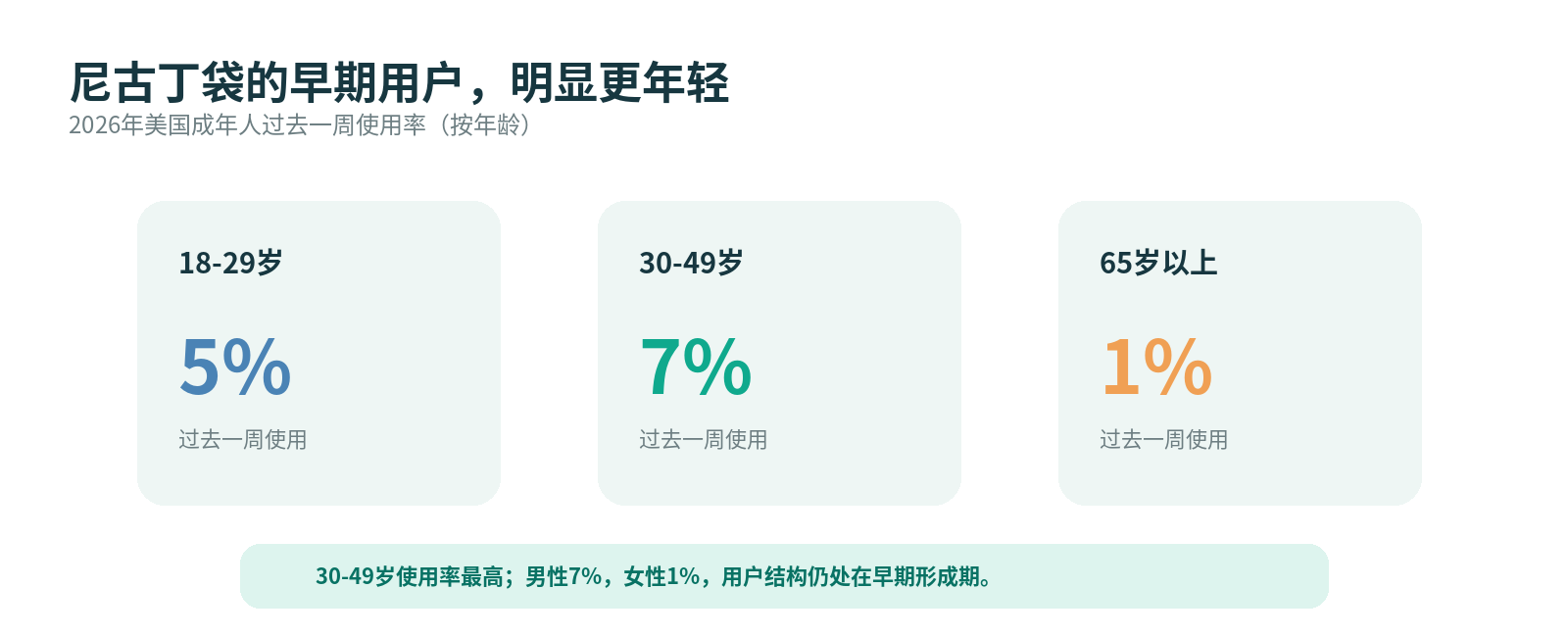
What deserves attention about that 4% is not just its absolute size but the user structure underneath it. Gallup data shows a 5% use rate among adults aged 18–29, 7% among 30–49, and only 1% among those over 65; 7% among men against 1% among women. Early nicotine pouch users are clearly concentrated among younger adults more willing to try a new format.
It needs no charging. There is no smoke and no ash, no coil, no heater and no after-sales servicing. For adult consumers it is more portable and more private, and it fits commuting, travel and social settings better. For brands it behaves more like a high-frequency repeat-purchase daily good, with a lighter supply chain, lighter merchandising and lighter cross-border shipping. The simpler the product, the faster it tends to replicate at scale.
From 23 Billion Pouches to Nearly $7 Billion
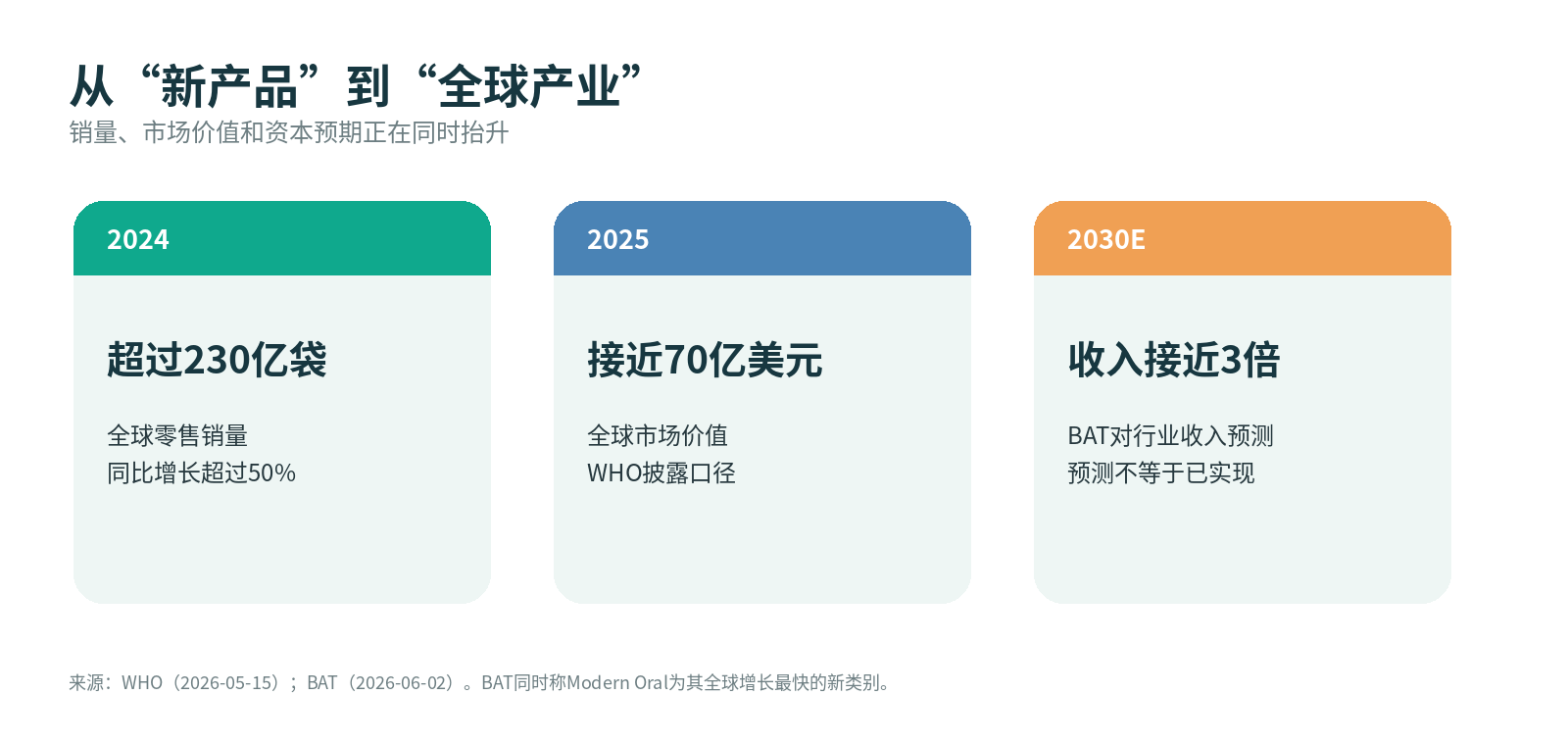
The United States is only a microcosm. The WHO reported global nicotine pouch retail volume above 23 billion pouches in 2024, growing more than 50% year on year, with global market value approaching $7 billion in 2025. In its 2026 investor communications BAT called Modern Oral the fastest-growing new category worldwide and projected industry revenue approaching three times the current level by 2030. The bases used by different organisations are not identical, but the shared direction is unambiguous: the category is still in rapid expansion.
Regulation has also started moving from blank space toward filtering for quality supply. The US FDA authorised twenty ZYN products for the first time in 2025, then in 2026 allowed those twenty to use a specific modified risk statement; as of 21 August 2026 the FDA’s list of legally authorised products had grown to 43. Authorisation does not mean safe, and it is not approval as a cessation medicine — but it does show that, for adults who already smoke, the relative harm-reduction value of switching completely away from cigarettes is gaining clearer institutional expression.
The Advantage Comes Precisely From Removing the Device
For the past decade competition in new tobacco products revolved around hardware: batteries, chips, atomiser structures, heating control and consumable matching. The nicotine pouch compresses all of that into three core variables — formulation, pouch material and packaging. No device barrier means a lower learning cost for the user, and it means a brand can put more of its resources into flavour, strength, release experience and visual identity.
Nicotine is of course addictive, and non-users and minors should not start. The genuinely beneficial scenario for nicotine pouches is helping adults who would otherwise keep smoking move away from combustion; used alongside cigarettes, the harm-reduction benefit is heavily discounted. The faster the category grows, the further ahead dose labelling, age restriction and child resistance have to run.
Packaging Is Not a Supporting Role — It Is the First Battleground on the Shelf
When the product goes into a pocket, a backpack or a car cubby, the packaging directly determines moisture sealing, drop resistance, opening feel and portability. When a brand enters the United States, the EU and the Nordics, the packaging also has to face child resistance, material compliance, label space and batch traceability. A plastic can that looks simple is becoming the shared carrier of product experience and regulatory requirement.

Suzhou Changqi focuses on plastic packaging for oral products, offering end-to-end support from industrial design, structural development, mould manufacture and precision injection moulding through to decoration, assembly and inspection. As published on the company site, it runs 20 injection moulding machines from 100T to 270T and a Class 100,000 GMP clean production environment, and offers food-contact-grade PP, child-resistant structures and a compostable PBS+PLA material option. For brands preparing to go overseas, the earlier packaging engineering, line tact time and target-market regulation are brought into step, the lower the risk of later tool changes and delivery problems.
Cigarettes will not disappear tomorrow, but the direction of growth has changed. 11% is the measure of an old category receding, 4% is the opening a new one has made, and 23 billion pouches prove the migration has reached industrial scale. What lasts will not only be the brands that can make a product, but the supply chains that can fit compliance, experience and consistent delivery into a single can.